Why High-Functioning Women Over-Explain Other People’s Behavior
When understanding becomes a form of emotional control within the self
There is a particular kind of person who can find an explanation for anyone’s behavior. If someone does not text back, they can think of five reasons why. If someone is inconsistent, unavailable, confusing, defensive, or pulling away, they may immediately begin filling in the blanks.
They’ll rationalize and say “Maybe that person is busy. Maybe they are overwhelmed. Maybe their relationship with someone scared them of intimacy. Maybe that person is going through something. Maybe they did not mean it that way. Maybe I am expecting too much”… you get the point. There is a quick reason and understanding.
Sometimes those explanations are accurate. And sometimes they are compassionate. But sometimes they also protect us from having to sit with a much more uncomfortable question: What if this person is simply not showing up in a way that works for me?
Some arrive at these explanations through therapy language and attachment theory. Others never use psychological language at all. The pattern can still be the same.
It is the mind trying to turn uncertainty into something understandable.
Over-Functioning Does Not Always Look Like People-Pleasing
We night think of over-functioning as people-pleasing: saying yes when you want to say no, avoiding conflict, suppressing your needs, or working hard to keep everyone around you comfortable.
But some high-functioning people, especially women do not identify with that at all. They may be confident, assertive, capable of confrontation, and perfectly able to speak their mind. Their over-functioning happens somewhere else. This can show up across dating, relationships, and attachment patterns, especially when understanding the other person starts to replace paying attention to your own experience.
Instead of constantly trying to keep the other person happy, they become extremely good at understanding them. They analyze, contextualize, explain, soften, and reframe. They try to make sense of what happened so thoroughly that they can stay steady inside it.
People-pleasing often says, If I keep you happy, I’ll be safe. Over-understanding says, If I can explain this, I’ll be safe.
People-pleasing manages the other person. Over-understanding manages your own vulnerability.
One is organized around managing the other person’s comfort. The other is organized around managing one’s own emotional uncertainty through meaning-making.
Some people do not abandon themselves by saying yes to everything. They abandon themselves by understanding everyone else too well.
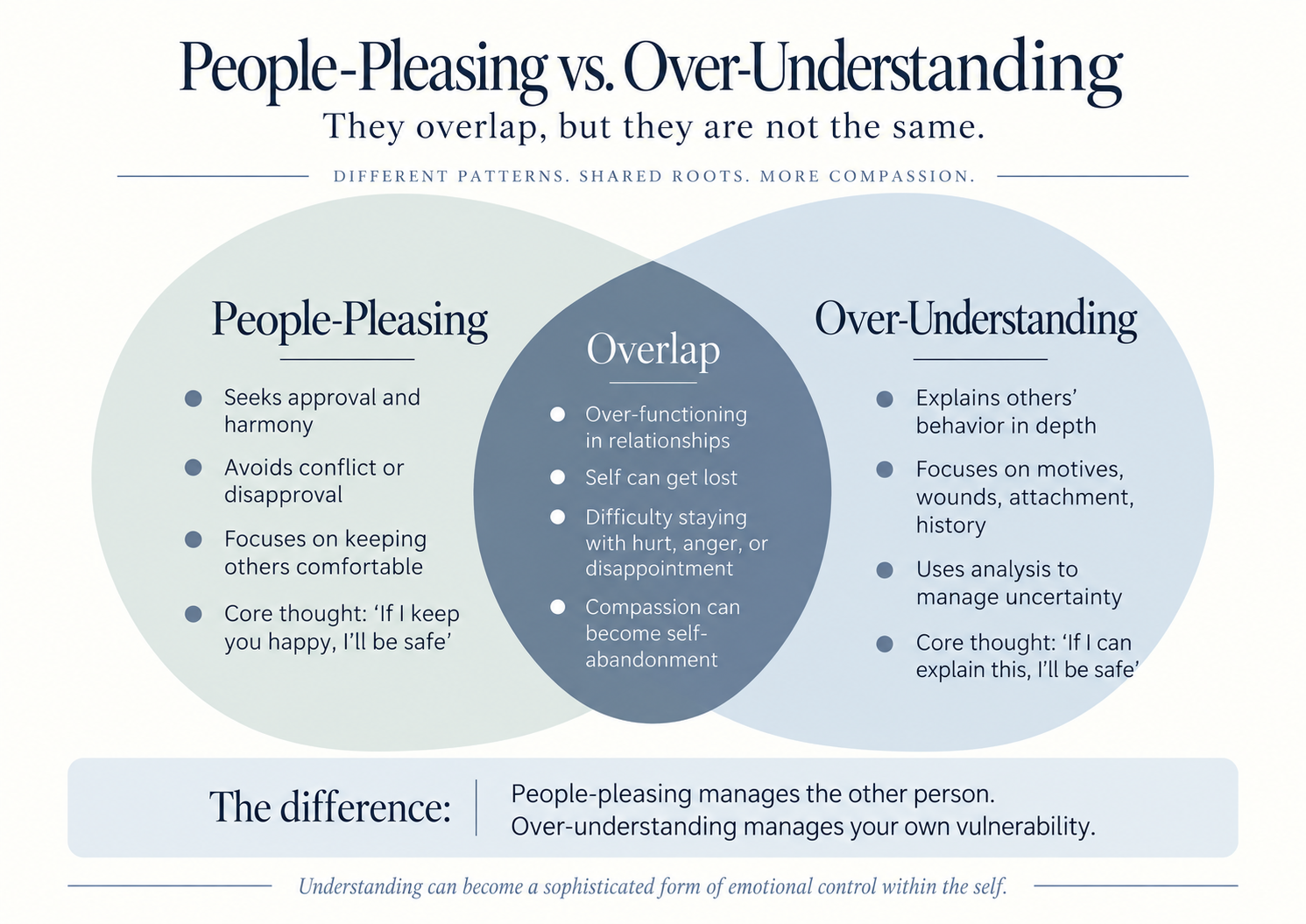
When Understanding Becomes a Form of Emotional Self Control
Understanding is not the problem. The question is what the understanding is doing for us.
The internal process might sound something like: Can I make sense of this enough that it stops feeling chaotic? Can I understand their wounds, motives, attachment style, history, and defenses so I can stay regulated and know what to do?
That question sounds psychologically sophisticated, and often it is. But it can also become a way of staying one step removed from disappointment, anger, grief, and vulnerability.
If you can explain why someone is withdrawing, maybe you feel less rejected. If you know their attachment history, maybe their inconsistency feels less personal. If you can identify their defenses, maybe you feel more prepared for what happens next.
Meaning creates order. And when something relational feels painful or uncertain, order can feel safer than helplessness.
If you stay in the position of compassion and interpretation, you retain a certain sense of competence and control. Hurt is messier. Anger is messier. Wanting somebody to show up differently makes you vulnerable.
Understanding can therefore become a very sophisticated form of emotional control. Not control over the other person, but control over your own emotional uncertainty.
Are You Being Compassionate, or Carrying the Relationship?
High-functioning individuals often believe relationships are figureoutable. If two people care enough, communicate enough, give each other the benefit of the doubt, understand each other’s wounds, and keep trying, then surely they can work through almost anything.
There is something hopeful and beautiful about that orientation. The problem is when only one person is doing the figuring out.
You initiate the conversation. You contextualize their behavior. You think about what they went through as a child. You remind yourself that they are overwhelmed. You try to understand their attachment style. You soften your interpretation. You offer another chance. You ask what you could have done differently.
At a certain point, a harder question has to enter the room: are you being compassionate, or are you carrying the relationship?
A relationship is not healthy simply because one person is capable of understanding both sides. A relationship is not mutual simply because one person is wise enough to keep repairing it. Mutuality requires two people who can each reflect, communicate, tolerate complexity, and bring their own internal world into the relationship.
The Interpreter Position Can Become a Hiding Place
This pattern can be especially seductive for therapists and psychologically minded people. We are trained to contextualize behavior. We understand that anger can protect vulnerability, withdrawal can protect shame, and inconsistency can come from attachment wounds. That knowledge is valuable. But in our own relationships, it can also allow us to step outside of ourselves and into the position of observer.
Instead of asking, What is happening to me here? we ask, What is happening psychologically for them? Instead of feeling hurt, we formulate. Instead of feeling angry, we contextualize. Instead of deciding that something does not work for us, we explain why the other person cannot currently offer it. At that point, emotional intelligence can quietly become a way of staying one step removed from our own experience.
Sometimes over-understanding moves us out of our own position in the relationship altogether. We take on the role of a third person, perhaps becoming the wise observer, almost like a therapist or mother archetype looking in from the outside: I understand why they need space. I understand why they cannot give me more. I understand why this is hard for them. But we are not outside observers of our own relationships. We are the people being affected by them. The question is not only what the other person needs or why they behave as they do, but also what their behavior is asking us to live with.
The Developmental Arc: Coming Full Circle
To clarify, learning to zoom out from a relational injury can be deeply healthy. For someone who tends to personalize everything, it can be transformative to realize that another person’s withdrawal, defensiveness, or inconsistency may reflect their own wounds and limitations rather than your worth.
But this capacity can become overdeveloped. Especially for therapists and highly reflective people, understanding can turn into a kind of emotional hyper-independence and mature protective mechanism. You become so good at seeing the dynamic from above that you stop allowing yourself to be fully inside it.
The next stage of development is not returning to reactivity. It is coming full circle, meaning being able to understand the other person and still let yourself be affected by what is true.
I can understand why you did this, and I am still hurt by you. That is not dysregulation. It is relational presence.
Understanding Someone Does Not Mean Their Behavior Works for You
You can understand why someone withdraws and still decide withdrawal does not work for you. You can understand their attachment history and still need consistency. You can understand their shame and still feel hurt by how they handled conflict.
You can understand why someone is not ready for intimacy and still decide that you do not want to remain in a relationship where intimacy is unavailable.
Insight does not obligate you to tolerate what hurts. Understanding someone’s behavior does not make the relational consequences of that behavior disappear.
Stop Asking Only “Why Are They Like This?”
For the over-understander, the developmental shift may be surprisingly simple.
Instead of asking only, Why are they like this? begin asking, What is it like for me to be with someone like this? Recognizing these patterns is often part of deeper work around dating, relationships, and attachment.
That question brings you back into the relationship. It shifts the focus from interpretation to experience.
Maybe their behavior makes perfect psychological sense. Maybe you understand exactly where it comes from. But what does being with that behavior do to you? Do you feel secure, confused, lonely, respected, exhausted, seen, hypervigilant, connected?
And perhaps the harder question is: Can I let myself not fully understand why they are doing this and still trust what the relationship feels like to me?
At times analysis gives us distance from a truth we already know.
Understanding Should Bring You Closer to Yourself, Too
The goal is not to become less compassionate. It is not to stop trying to understand people. It is to make sure your empathy extends in both directions. Understanding should help you see another person more clearly, but it should also help you see yourself more clearly.
Sometimes the work is not understanding the other person better. Sometimes the work is tolerating the vulnerability of knowing what their behavior means for you.
Ready to Look at Your Relationship Patterns More Closely?
If you recognize yourself in these patterns and want to understand how they show up in your own relationships, individual therapy can offer a space to explore them more deeply. You can also schedule a consultation to see if working together feels like a good fit.